 robban
Thanks guys!:)
This will be busy year. Plenty of airshows in Sweden. In a few weeks there will be a large airshow in Linköping.
The program will include:
Bleriot XI, Sk16, B17, Cub, DC-3, J28 Vampire, J29 Tunnan, J34, Hawker Hunter Helikopter 4, 5, 6, 10, 14, 15, Breitling Jet Team, C-17, Tummelisa, Sk50, Sk61, Tiger Moth, Tp 100, J32 Lansen, Spitfire Mk XVI, P-51 Mustang, J35 Draken, Sk37 Viggen, JAS 39 (4 group), Tp 84 Hercules, Sk60.
🙂
robbanAFAIK, there will be one AJ37 and one SK37 airworthy in the future. Most people would like to see the JA37 flying again, but its systems are too advanced and expensive for this to happen. The AJ37 and SK37 have more analogue technology than the JA37.
There is one J35J Draken waiting to get airborne in the future. It hasn´t flown for many years because the ejection seat needs to be cleared for use first.
robbanThanks guys! Glad you like them!:)
@pagen01
An Sk37 Viggen has been ready for two weeks now, and would have flown at this airshow, however there were still some paper work that needed to be done. So, next time, perhaps?
robbanThe comments below are written by a friend of mine, and he wants to be anonymous. But he knows his stuff, well he has to, it is required in his profession.:)
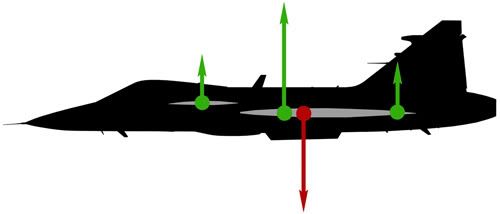
I am always a little uncomfortable about getting involved in these “which is the better” configuration discussions. The reason is that it is very often a function of the specific design requirements of the aircraft you are designing. Consider this: When Gripen (and many other modern aircraft) was designed, one of the strong candidate configurations was a conventional layout (albeit with a funny location for the engine intake). Now, if teams of aeronautical engineers, some with PhD’s in aerodynamics, decided that it would take some serious study and wind tunnel tests to decide which configuration was better, then maybe the answer isn’t so simple? Sometimes the final choice is dictated by one particular design requirement which the client regards as essential, but that another client may have had no particular interest in – here I am for example thinking of Gripen’s ability to generate a strong download on the nose gear and main gears with the canards and elevons after landing, which combined with a brake in the nose gear allows very strong braking after landing.
About upload and download on the canards, it is not nearly as simple as some posters think. I think I understand why they think a download is required from the canards when unstable – their argument is that a CG behind the main wing aerodynamic centre automatically goes along with a nose-up pitching moment. They forget that you need to split trim requirements and stability requirements – the two are completely different concepts. The trim requirements are functions of the pitching moment of the aircraft as a whole. For example, you can place the CG behind the neutral point of the canard/wing/fuselage combination, which would make the aircraft statically unstable. However, at the same time you could deflect the elevons down (which has no effect on static stability) which would cause a strong downward pitching moment which you would have to counter by deflecting the canards leading edge up. So, the pitching moment of the wing and other control surfaces influence the trim requirements in addition with the current CG location. With short coupled canards like on Gripen, there is also a mutual interference effect that makes the whole situation more complex.
Both the conventional tail and canard configuration, even when highly unstable subsonic, usually go stable when supersonic due to the shift in the wing and canard neutral point when passing through the transonic regime. There are some interesting advantages here when you have a canard, as it is almost unavoidable to require a strong download on a conventional tail but even when supersonic you sit with positive lift on the canard. The advantage here is more related to trim drag and controllability, as well as turn performance in the transonic and low supersonic regime. I think people sometimes think “relaxed stability” or unstable means unstable throughout the flight envelope. Aircraft that are unstable through the entire envelope (subsonic, transonic and supersonic) would require such a high level of instability in the subsonic regime that they would end up with severe controllability issues, unless, of course, they make use of a wing sweep mechanism which has its own practical problems.
You are right that the canard can act like a LERX, and in general you have a littlebit more freedom with canard/elevon combinations to decouple direct force and pitch control from each other. However, there are ways to achieve similar things with conventional configurations, which again brings me back to the fact that the choice of configuration is seldom obvious from the beginning.
You are correct about the lift/drag scheduling. Gripen and other modern canard aircraft makes use of this to minimise drag throughout the envelope and it is very effective.
robbanthe F-22 still has tailplanes and has 28 deg/s STR with modern technology
28 deg/sec STR? Considering the source, you actually believe it to be true?
robbanThe videos are not comparable unless they are done at the same speed and height.
The MiG-29 does not bleed energy as you claim, the Gripen is the one that bleeds energy more, why? It starts its turn at 30 deg/s but can not sustain it so it drops to 20 deg/s so now tell me who is bleeding energy, the MiG-29A that starts at 28 deg/s but can not keep the 28 deg/s turn so it drops to a 22deg/s STR?
I’d say the altitude is similar, speed, who knows, close enough I think.
Look at the vids again. Which aircraft starts the turn with a turn rate it can’t sustain, bleeding alot of speed in the process? Hint, it’s not the Gripen.
robbanThe STR of the Gripen is known it is 20 deg/s lower than the F-16`s 21.6 deg/s and 21 deg/s of the Su-27 most used STR figure for the MiG-29A is 22 deg/s, taken from ex-Warsaw pact machines.
Now, compare the TWR of these aircraft. Also, the 21.6deg/sec for the F-16 is not up to date. AFAIK, the latest versions of the F-16C/D is 18deg/sec. However, if we go by the 21.6 figure, performed by an early Block F-16A, the A still had a much higher TWR compared to a Gripen.
As to the 22deg/sec MiG-29 turn rate, I´m sceptical. While the ITR of the MiG-29 is good, around 28deg/sec, it´s sustained turn rate is rather poor. It bleeds energy like crazy in sharp turns. I know an airshow performance isn´t the most scientific way to judge an aircrafts performance, but the MiG-29 is rather sluggish, especially in comparison to the eurocanards, as well as by a well flown F-16.
In the video below at 1:58, a MiG-29 makes a 360 in around 16 seconds, notice that when it enters the turn it has plenty of speed, and when it exits the turn it travels at a much lower speed.
http://www.youtube.com/watch?v=FHcgqHehP5w&feature=related
In the video below, at 3:32 you can see a Gripen perform a 360 in 16 seconds, with no visible speed loss.
robbanthe test flight video is quite clearly a CGI. How else can one explain the sudden disappearance of the model in flight when the clouds around it are still there ? See the attached screenshot.
It’s not CGI. The clouds visible on both screenshots comes from the next screen. Notice how the clouds have less contrast on the first shot. Also the aircraft is slightly faded as well on the first shot.
robbanThe Draken is almost 60 years old, of course it wont have as stable characteristics as an Su-27. And, sure the maneuver might not be as safe to do in a Draken, but, it’s the same maneuver. A rapid pitch up, high AoA, high E-bleed maneuver.
robbanIt simply is not the cobra, the Cobra is russian not swedish and was made for the first time on a Su-27, and its named in honor of a russian pilot
Very likely it banks because the Drakken experiments lateral stability problems, in order to do it straight you have to have total lateral stability.
It is simply a maneuver made famous by the russians. I bet you there are many aircrafts out there that are able to perform the same maneuver. It’s just so overhyped.
robbanThe gripen has 45 wing and 45 canard
No.

A Gripen with a 45 degree sweep would have to look like this.

robbanWell the Draken is less advanced aerodynamically speaking, and it doesn´t have FBW. The MiG-29A/C for example is stable, and it also lack FBW. So it´s cobra is “rougher” in comparison to the Su-27´s.
The maneuver done by the Draken in the vid is a rapid pitch up to a very high AoA, with a loss of speed as a result. It may look a little rough, but I fail to see how this is different to a Cobra done by an Su-27.
robbanThe canard usually is less swept than the wing,
That´s not true. The canard on the Gripen is more swept than the main wing, as is the canard on the MiG 1.44. The Viggen, Rafale, J-10 and Lavi have the same sweep angle on their canards in comparison to thier main wing. Only the Eurofighter, Kfir and Mirages retrofitted with canards have less sweep.
robbanDraken doing a cobra maneuver @ 1:51. http://www.youtube.com/watch?v=jqiDEcfSnXs&feature=fvsr
in the Viggen book by Flyghistorisk Revy, a Viggen pilot says this maneuver was very much achievable with the Viggen as well. What´s the big deal?
robbanTrue true. Bias and prejudice sucks. But I guess we’re all guilty of that from time to time. 🙁


 Sign In







