Indeed, a stunning shot!
Fantastic photos of beautiful aircraft! Thanks for sharing!:)
The Safir is a great plane in so many ways. I have 250+ hours in Cessnas, Pipers, Mooneys etc. All great aircraft, but the Safir flies so much better. it’s really light on the controls, rolls and loops are made relatively easy. Plus, the six cylinder engine has a nice sound to it.:)
What is the significance of the diamond markings on the top of the Lansen fuselage?
They are called Ö-68 rutor in swedish. Ö is short for övning, meaning exercise, and 68 is the year. This Lansen wears the markings worn during this exercise in 1968. 🙂
I do not deny tail cross section has an impact of drag, but remember aircraft life the F-16, T-50, Su-27, MiG-29 have integral wings that blend with the fuselage increasing lift and reducing drag, the Gripen has not that extra lift.
The main wing on the Gripen and Rafale also blends with the fuselage. The fuselage lift on the F-16 and MiG-29 for example comes from the LEX, wich only increases lift at certain AoA. Most of the time it´s just a weight and drag penalty. The canards offers lift, but for all speeds and AoA, and they offer optimal lift/drag ratio, as they are adjustable. Also, they are small, meaning little weight and drag.
Robban
Applying the elevons as control devices at pitch is another way of dealing with the problem in the same way a tailess wing aircraft uses them as pitch control devices, however why do you think most aircraft have tails or canards? simply because this free the wing from being a pitch control device and any tail or canard have a longer moment arm.
A Gripen doesn´t use the elevons to create a pitching moment. That´s the canards job. The elevons helps control the pitch rate after the pitch is initiated. In other words, the elevons add lift, so that the canards doesn´t have to kill lift.
Are you with me on this?
Robban
I think the main advantage of the unstable canard configuration is it will have a very strong pitch up force at turns so it will enhance its ITR greatly,
It´s just one of the advantages, and it´s not the main one. The delta/canard config offers many advantages.
while making unstable a tailed aircraft you are making it a better supercruiser, since a tailheavy aircraft needs kill lift on a canard wing configuration by reducing canard lift;
Not true. Read my post above. The elevons aren’t just for show. They work similar to a taileron. Why would all the work fall on the canard? The canards and elevons work together. The canards can quickly kill lift if it needs to, but by instead decreasing(not talking negative lift here) the lift on the canard and increasing lift with elevons, stopping a pitch moment is possible.
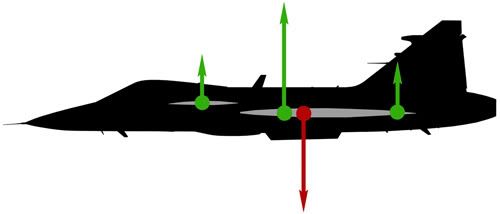
Stop focusing so much on the canard. All the control surface work together. See my drawing.

Thanks Björn. 🙂
I use a Nikon D300 and a Sigma 50-500. I love the D300, and the Sigma is a good “budget” alternative to the considerably more expensive Nikon lenses. Previously I used a D70s and a Nikkor 70-300 lens. The D300 and Sigma combo was quite a leap forward IMO.
Sigma now offers a 150-500 with VR, and it might be a good buy. But I like the 50-500.
interesting drawing
http://img245.imageshack.us/f/canardvstailhc5.jpg/
In a conventional configuration the tailplane needs a down force to stabilize the nose down force but in a unstable it needs an up force to balance the tail heavy aircraft it is exactly the opposite in the canard wing aircraft
at the begining of the pitch up force an unstable canard delta wing configuration will allow its lift to generate a pitch up force but as it nears its max pitch up speed it will generate a nose down force, exactly the opposite is with an unstable tailplane wing configuration.
The graph doens’t tell the whole story/truth. Just like the tailerons on an unstable conventional configuration, the elevons helps control the pitch moment. As the canard is a moving surface it works in conjunction with the elevons to control pitch. The advantage for the delta/canard is that positive lift is avaliable all the time, even when initiating a pitch moment. The control surface inputs to achieve a similar pitch rate is considerably smaller for a delta/canard. More lift, less drag. It’s a lift/lift situation. The canard works as a moveable LEX. It is adjusted automatically to give optimum lift/drag at all speeds and AoA, contrary to the considerably less flexible and draggy LEX on the F-16, MiG-29 etc.
The graph you posted is made by Dwight Looi of the WAFF forums. I’d be careful to build a case on it.

Awesome photos!:)
Excellent photos!
How I´d love to see a P-40 and a Catalina fly here in Sweden! I saw the Eurofighter perform at Rygge in Norway a few years back. Such a powerful machine!:)
What a fantastic set of photos, Björn! Judging from your shots of the Gripen taxiing to go home, I think we were standing pretty close to each other.
I hope you will visit the airshow in Linköping on June 13?
Again, fantastic photos!:)
Glad you like them!
I´m enjoying this as much as I can. There is a healthy general interest in aviation in Sweden, but there are “evil” forces who´d, I´m sure like nothing better than to scrap these machines and forget about their existence. We´ll see after the next election if there will be a future for military aviation, and airshows in Sweden. Here´s hoping!:)
The Safir really does have a rather low ground clearance. But it`s easy to fly and land so, no problems there.:)
Thanks guys, glad you like them!:)